
Air Duct Cleaning: Repair or Replace? How Costa Mesa Homeowners Decide
Cleaning is the right call only when the duct structure itself is sound. If the ducts are still airtight and the material hasn’t broken down, clean them. If sections are crushed, torn, or shedding fibers, cleaning can make things worse by loosening debris you can’t capture. Before anyone quotes you a cleaning, ask one question: has anyone actually looked inside the ducts? If the answer is no, keep your wallet closed for now.
If you’d rather not crawl into the attic yourself, call (855) 337-2150 and we’ll take a look with a camera and tell you plainly which of the three paths you’re on: clean, repair, or replace.
Why duct material and age decide the answer before anything else
In Costa Mesa, most homes fall into one of three duct construction types, and each one fails on a different schedule. The material tells you what to inspect for, and it often settles the clean-versus-replace question before a single dollar gets discussed.
- Flex duct. The most common in Orange County homes built or retrofitted in the 1980s and 1990s. The outer jacket tears, the wire core kinks at tight radius turns, and the inner liner degrades over time. The pre-2000 flex is the sneaky one: the inner liner can break down into fine fibers. Running a brush through that duct doesn’t remove the fibers, it knocks them loose into the airstream and into the rooms you’re trying to keep clean.
- Fiberglass duct board. Common in soffit chases and return trunks. The coating on the inside can crack or peel, and once the raw fiberglass is exposed, cleaning can abrade it further. A technician should check for surface erosion, especially at seams and corners.
- Sheet metal. The most durable of the three. It doesn’t shed. What fails is the joints and the seams, where old tape peels and mastic cracks. Sheet metal usually survives decades with re-sealing; it rarely needs wholesale replacement unless it’s been crushed or water-damaged.
A Costa Mesa house near the coast built in the 1970s will often still have its original flex runs in the attic, and that’s where the audit should start. Look at the material first, then the age, then the condition.
Why a camera inspection is the pivot point for any recommendation
No cleaning or replacement recommendation is worth a nickel without camera footage of the duct interior. Fiber condition, dust type, moisture, joint integrity, and crushed sections are all invisible from the outside of the duct. A technician who’s only looked at the vents and the air handler is guessing.
What the footage should show you, in real time, before any work starts:
- The inside of the main trunk, both supply and return sides.
- A close-up of at least one flexible run from start to finish where it connects to the boot.
- The condition of the liner surface, whether it’s intact, delaminating, or shedding.
- Any crushed or kinked sections, which will show up as pinched cross-sections.
- Moisture or staining, which points to a leak and to a bigger conversation.
At Costa Mesa Air Duct Cleaning Co, we show you what we find before we clean it, and we show you the same runs after. If the footage shows a failed liner, we say so, and we say it before the equipment comes off the truck. In our experience, most of the “should I replace this?” confusion in Costa Mesa comes from a recommendation made without any visual record at all. A camera doesn’t just help the homeowner; it keeps the recommendation honest.
The three scenarios, side by side
Here’s the cost math in plain terms. Prices vary with the size of the system, the number of runs, and the access in the attic, but the structure of the decision is the same in any Costa Mesa home. Get every quote in writing that separates labor from materials.
| Scenario | What it involves | When it’s the right call |
|---|---|---|
| Clean only | Full-system air duct cleaning with negative-air containment and contact cleaning of every run | Duct structure is intact, liner is sound, dust or debris is the only issue |
| Clean plus repair | Cleaning plus sealing leaking joints and replacing isolated crushed runs | Most of the system is sound, but a handful of joints or runs have failed |
| Replace | New ductwork, typically flex or sheet metal, with new boots and sealed connections | Liner is degrading, multiple runs are crushed, or moisture has compromised the system |
When you ask for quotes, insist on a line-by-line breakdown: footage review, labor per run, sealing materials, sanitizing step, and any new duct material. A single lump-sum number hides where the money goes and makes it impossible to compare bids fairly. A quote that won’t itemize isn’t a quote; it’s a wish.
When partial replacement beats ripping out the whole system
Whole-system replacement is often unnecessary. In many Costa Mesa homes, the main trunk is fine and the problem sits in two or three attic runs that were poorly installed or have pinch points at the boot. That’s a partial-replacement job, not a full rebuild.
Two pieces of data tell you which runs are compromised and which are still good:
- Static pressure readings. A system reading outside the manufacturer’s spec, combined with a camera view of a specific pinched run, points straight at the problem section.
- Visual data. A crushed run has a visibly reduced cross-section on camera. A sound run looks round and smooth inside.
Replacing the failed runs and sealing the joints is often the most cost-effective path. The full rebuild makes sense when the liner is breaking down across most of the system, moisture has soaked into duct board, or the layout itself is wrong. Those are structural decisions, not cleaning decisions, and the camera footage is what separates them.
Mastic, duct tape, and Aeroseal: sealing done right
This is where cut-rate bids reveal themselves. If someone shows up with a roll of silver duct tape and calls that a seal, send them back out the door. Duct tape fails in attic heat within a couple of seasons; it peels, dries out, and leaves the leaks right where they were.
- Mastic sealing is the workhorse. A brush-applied sealant over every joint, seam, and boot connection. It’s the right call for accessible joints and is standard on any partial repair.
- Aeroseal is a sealant fog that travels through the ductwork and coats the leaks from the inside. It’s useful for leaks you can’t reach, but it’s not a cure for crushed runs or a failed liner, and it’s not cheap.
- Duct tape is never the long-term answer. It’s the wrong tool used by someone who doesn’t want to do the real job.
For a home in Costa Mesa with a handful of leaking joints, mastic is the honest fix. For a system with hidden leaks in walls or chases, Aeroseal may be the right supplement. The point is to seal what’s there before cleaning if the leaks are pulling attic air into the living space.
How each duct type is inspected in a Costa Mesa attic
Duct material dictates the checklist. A technician who uses the same inspection routine on flex, duct board, and sheet metal is skipping the parts that matter.
- Flex duct: check for kinks at every 90-degree turn, jacket tears at the boot, liner separation at the collar, and sagging between hangers.
- Fiberglass duct board: look for coating erosion at seams and corners, moisture staining, and any spot where the raw fiberglass shows.
- Sheet metal: check every taped joint, look for popped mastic, and confirm the duct hasn’t been dented or crushed during a previous attic repair.
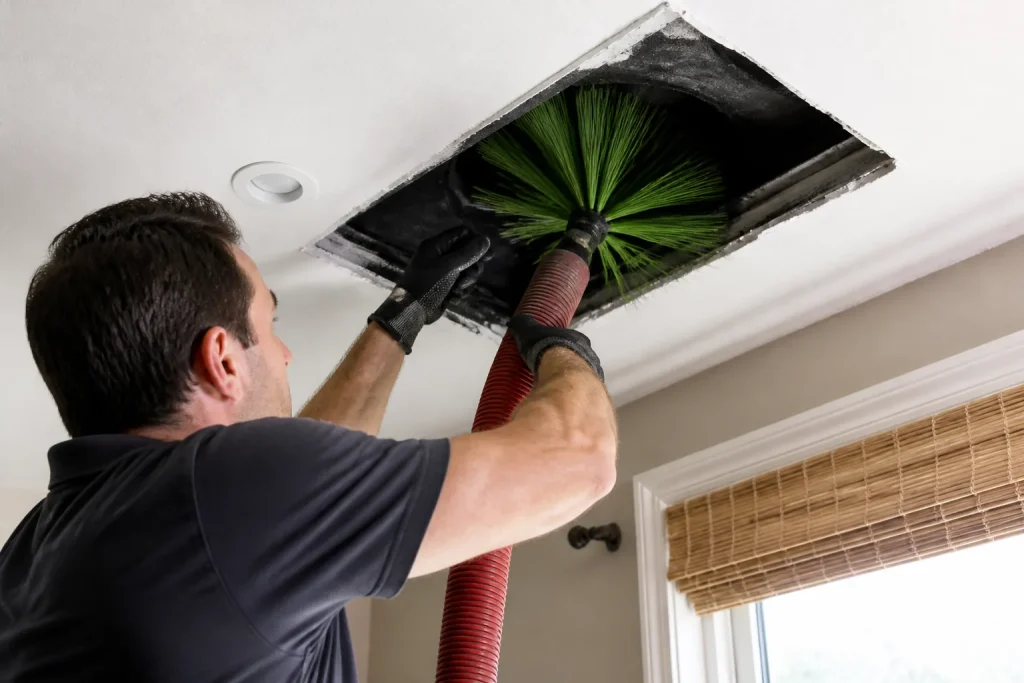
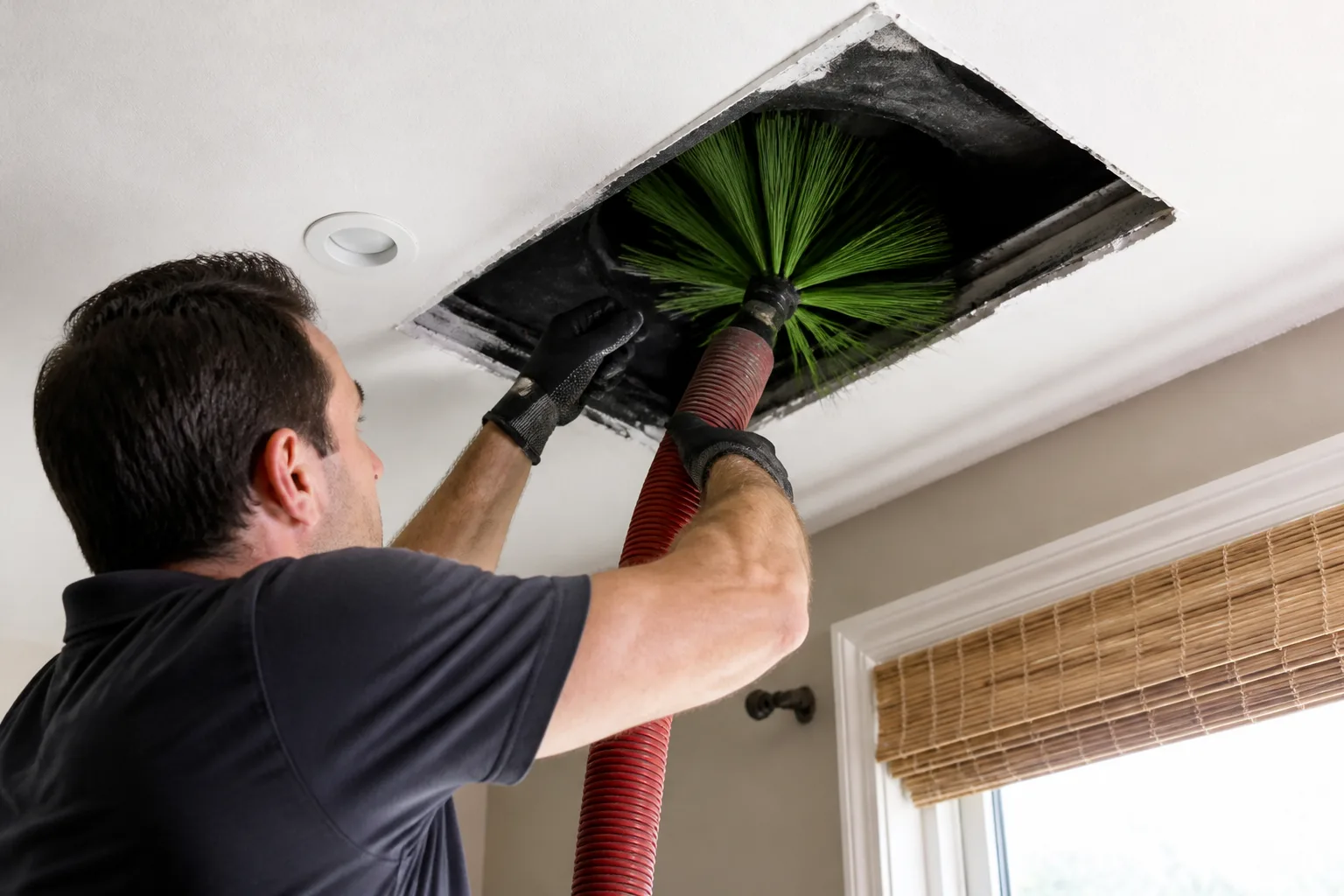
Attic conditions in Costa Mesa are tough on ductwork: the summer heat up there accelerates tape failure, and anything that’s been in place since the house was built is a candidate for seal failure. That’s why a proper inspection means opening the plenum and walking the runs, not just peeking through a vent register. We do that inspection with a Rotobrush or Nikro setup on hand, so if the answer is “clean it,” we’re already there, and if the answer is “repair it,” we’re not handing you off to someone else.
When to call a pro instead of looking yourself
You can check the accessible filter and listen for whistle or rattle at the registers. What you can’t safely do is crawl a hot attic and inspect duct insulation, joints, and connections on your own, or move the air handler to check the plenum. Call us when you spot any of these:
- Whistling or whooshing at supply registers, which signals a leak or pressure problem.
- Dust settling quickly on surfaces after a recent cleaning.
- A musty smell when the system turns on.
- Visible dust or fiber shedding from a vent.
- Any attic ductwork showing sagging or visible tears.
Related services in Costa Mesa: HVAC cleaning and dryer vent cleaning often travel with a full-system inspection, and we handle both on the same visit.
The Bottom Line
Here’s the framework in one paragraph. Look at the material. Look at the age. Look inside the duct with a camera. If the liner is intact and the joints are sealed, cleaning is the answer. If a few runs are crushed or leaking, clean and repair them. If the liner is breaking down or moisture has soaked into the system, replace what’s failed, not the entire system unless the footage says so. Get quotes that separate labor from materials, demand camera footage on every recommendation, and never accept duct tape as a seal.
If you’re in Costa Mesa and need help, Costa Mesa Air Duct Cleaning Co offers free estimates. We use Rotobrush and Nikro equipment, the same systems professional HVAC and restoration contractors rely on, and we back the work with a documented sanitizing step using Guardsman products at the close of any eligible job. One call covers the full air pathway: Costa Mesa Air Duct Cleaning Co can clean, repair, seal, and sanitize without sending you to a second contractor. Call (855) 337-2150 for a free estimate. We answer 24/7. Fast dispatch from 7am to 7pm, Sunday through Friday.
Frequently Asked Questions
Most Costa Mesa homes land in a mid-range whole-system range for cleaning, and that range depends on the number of runs, access, and whether repair or sealing is included. The written estimate you receive sets the final price, and a per-vent quote is a red flag. Call (855) 337-2150 for an exact quote. Estimates are free.
The duct material, age, and camera footage decide it. Age alone doesn’t force replacement; a pre-2000 flex system can still be clean-worthy if the liner is intact and the dust is the only problem. If the liner is breaking down or runs are crushed, cleaning won’t fix it. A camera inspection is the only honest way to tell. Call (855) 337-2150 to book one.
Low quotes usually skip the negative-air containment, the camera inspection, and the seal step, and sometimes skip cleaning past the first few feet of the run. The price you see is a door-opener, not a whole-system job. Ask what equipment goes in the van and whether they show you footage. Call (855) 337-2150 for a quote that covers the full job.
For most homes, every few years is enough if the system is sealed. Move up the schedule after a renovation, after a mold or moisture event, or if anyone in the house has allergy symptoms that flare when the system runs. If the liner is failing, cleaning isn’t the answer; repair comes first. Call (855) 337-2150 to talk through your situation.
Written by the team at Costa Mesa Air Duct Cleaning Co.
Need Air Duct Cleaning Help?
Call Costa Mesa Air Duct Cleaning Co - the local pro we connect you with is licensed and insured, here with fast help in Costa Mesa.
(855) 337-2150