
Abatement Technologies Air Duct Cleaning in Costa Mesa: A Homeowner’s Guide
Most homeowners in Costa Mesa assume duct cleaning means one thing: a machine pulls air through the system and the dust goes away. In our experience, the part people miss is what happens to the particles the machine doesn’t catch. Abatement Technologies equipment treats that as the core problem rather than an afterthought. Here’s what Abatement Technologies duct cleaning actually involves, when it’s the right tool for a Costa Mesa home, and when a standard cleaning is the sensible call.
If you’d rather skip the research and get a straight answer about your own system, call us at (855) 337-2150. Estimates are free.
What is Abatement Technologies equipment, and why does it matter in Costa Mesa?
Abatement Technologies is a brand built for containment. Its negative-air machines were developed for contaminated environments – mold remediation, asbestos abatement, and industrial cleanup – where the goal is to capture particulates rather than simply move them. That origin matters for households where the inside of the ductwork is the source of the problem, not just a place where lint has collected.
Standard truck-mounted duct cleaning works by pulling air outward through the system under high vacuum. It does a solid job on routine dust, settled debris, and the normal build-up you’d expect in a Costa Mesa home near the 55 freeway or along Harbor Boulevard, where traffic particulates settle indoors over time. What it doesn’t always do is trap the finest particles before they escape back into the living space.
That’s where Abatement-class equipment changes the equation. Instead of relying on airflow and a filter bag, these units combine a sealed containment strategy with HEPA-filtered exhaust, so whatever the machine stirs up gets captured rather than recirculated. For a home with a musty smell, visible growth around a register, or a recent remodel that left fine silica floating through the house, that difference is the whole point.
What does HEPA filtration at 99.97% actually mean?
A HEPA filter is rated to capture 99.97% of particles at 0.3 microns. That’s a number most duct cleaning sites throw around without explaining. Here’s what it covers in practice:
- Mold spores – typically 1 to 30 microns, comfortably inside HEPA range, which matters when ductwork has stayed damp through a humid stretch of Costa Mesa summer.
- Fine silica from drywall – the powder left behind after a renovation, small enough to stay airborne for hours and small enough to lodge deep in the lungs.
- Pet dander – in the 2 to 10 micron band, easily airborne and easily recirculated by a running HVAC system.
- Combustion particulates – the sub-micron fraction from cooking, candles, and nearby vehicle exhaust.
Why 0.3 microns, specifically? It’s roughly the hardest particle size for a filter to catch, straddling the line between the large and small. A filter that hits 99.97% there is tested at the toughest point, which is why the standard gets quoted. What it means for your Costa Mesa home: the finest, most respirable particles – the ones that hang in the air and reach the lungs – are the ones the equipment is engineered to trap.
When does a Costa Mesa home need Abatement-class equipment?
Not every job needs it. Any honest technician should tell you so. A home with a normal 12-month dust cycle, no odor, and no recent renovation usually costs less and gets a solid result from standard truck-mount cleaning. Abatement-class equipment earns its place in a narrower set of situations:
- Mold suspicion – visible growth near registers, a persistent musty smell, or a prior moisture event. The equipment contains spores during extraction rather than dispersing them.
- Post-renovation dust – drywall dust and silica from a recent remodel. The fine silica is exactly what a HEPA-negative-air setup is designed for.
- Allergy or asthma triggers – where the household is trying to reduce fine particulate in the air delivered to bedrooms and living areas.
- Animal or pest contamination – where the source is not just dust but biological debris.
- Long-deferred or never-cleaned systems – where the build-up is heavy enough that a standard pass risks spreading it.
A worthwhile technician will inspect the system, show you what’s there, and explain which approach fits. If the answer is “standard cleaning is enough,” take it. That’s the right call, and it’s the cheaper one.
How does negative air capture work, step by step?
Negative-air containment is about controlled pressure, not just suction. Here’s the general sequence a trained technician follows:
- 1
Isolate the section – the duct run being cleaned is sealed off from the rest of the system and from the living space, usually at registers and the air handler.
- 2
Set up the containment unit – the Abatement Technologies machine is connected so it draws air from the isolated run through a HEPA filter and exhausts clean air.
- 3
Verify pressure differential – a gauge confirms the isolated section is at negative pressure relative to the room, meaning air flows into the containment rather than out of it.
- 4
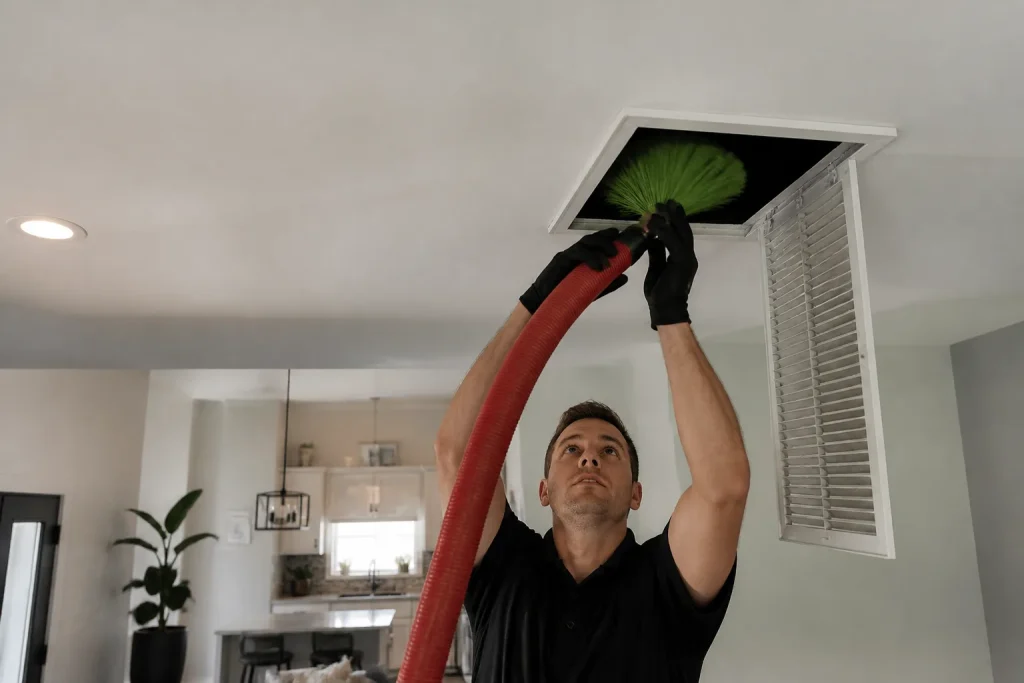
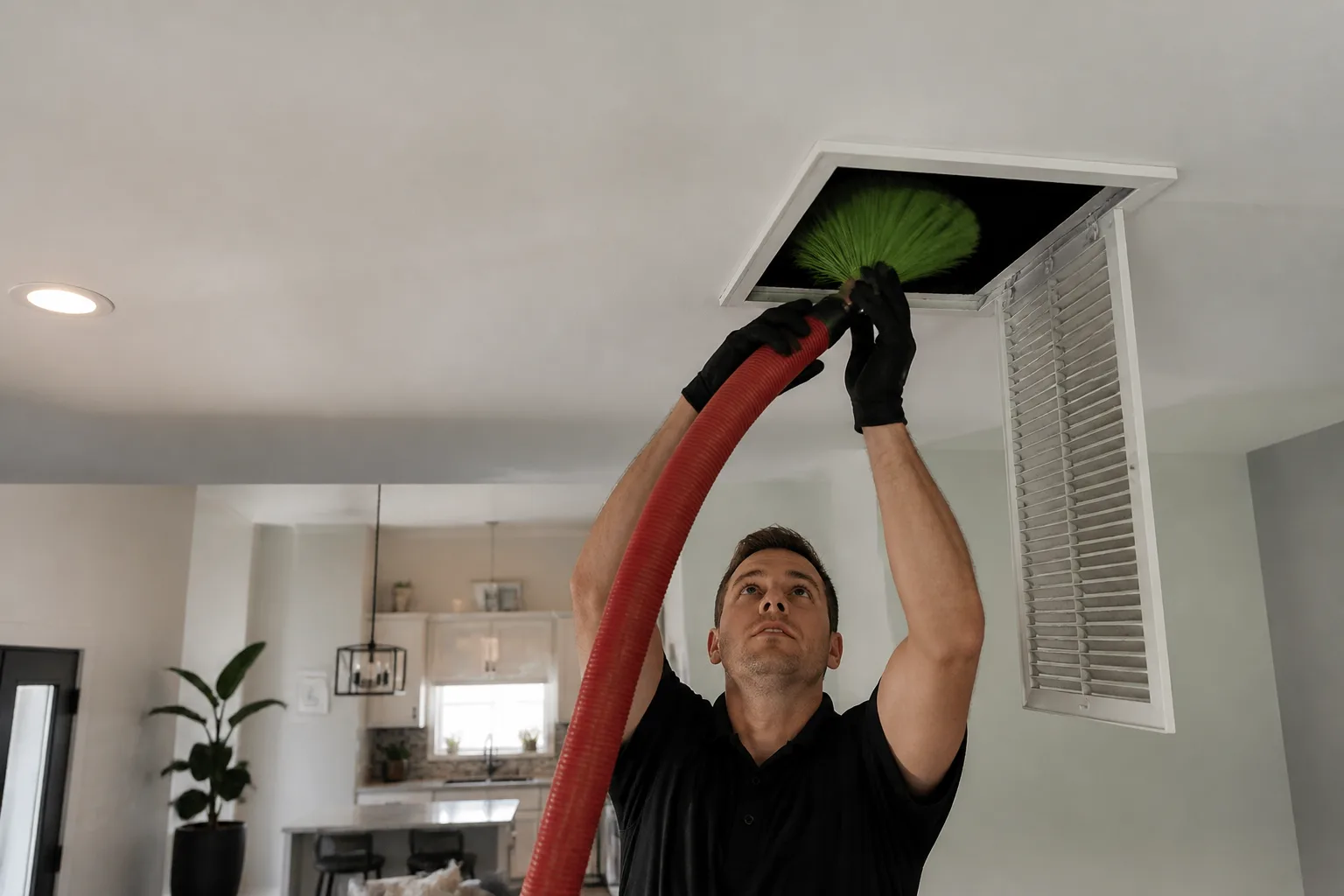
Agitate and extract – rotating brush and air tools (in our case, Rotobrush and Nikro systems) loosen debris while the negative-air unit captures it at the filter.
- 5
Confirm containment held – the pressure is checked again to make sure nothing lost its seal mid-job.
- 6
Close out with Guardsman sanitizing – a named, traceable disinfection step applied to the cleaned surfaces.
Every step depends on the previous one holding. A containment setup with a leaky seal is just a machine that pulls air from the wrong place. That’s why the pressure verification matters as much as the equipment itself. In our experience, most of the difference between a contained job and a messy one comes down to whether the technician actually checked the gauge.
How do you verify the job was done right?
For high-contamination situations, the honest answer is that you measure rather than assume. Post-remediation verification uses air sampling or spore trap testing: a sample of the air is captured before and after, then analyzed by a lab to compare spore counts. A meaningful drop confirms the cleaning worked. A flat result means something was missed.
When mold or biological contamination was involved, you can also ask for third-party confirmation from an independent indoor-air-quality assessor, someone who didn’t perform the cleaning. That separation is worth the small extra cost when the stakes are high – it’s the difference between a technician’s word and a lab result.
For routine jobs, verification is simpler. Before-and-after photos of your own ductwork work well. Ask to see the inside of the duct before extraction begins and again after, and look at the return plenum and coil too. In a Costa Mesa home where you’ve paid for a full clean, those photos should show a real change. If a company won’t show you the work, that tells you something.
When should you call a pro instead of handling it yourself?
Consumer-grade shop vacuums and duct-cleaning kits reach about as far as your arm, and they can stir up more contaminants than they remove if there’s no HEPA filter to catch the fine fraction. The situations where we’d genuinely recommend a professional evaluation:
- You can see or smell mold anywhere in the system.
- You’ve just finished a renovation and drywall dust has circulated.
- You’re getting unexplained allergy symptoms that improve when you’re away from home.
- The system has never been cleaned and the home has been through a moisture event.
We answer 24/7 and dispatch crews 7am to 7pm, Sunday through Friday. If you’re not sure which type of cleaning you need, a technician can inspect and give you a straight answer. One flat price per system, agreed before work starts, and photos of your own ducts before and after.
Related services in Costa Mesa
Duct cleaning is one piece of the full air pathway. If you’re scheduling work, it’s worth knowing that air duct cleaning pairs naturally with HVAC cleaning, since the coil and air handler hold as much debris as the ducts themselves. A clogged dryer vent cleaning is a separate fire-safety matter that we also handle in the same visit. And if you’re replacing filtration or humidity equipment, Honeywell and Aprilaire solutions can be installed alongside the cleaning rather than as a separate contractor’s job. Everything ties back to Costa Mesa Air Duct Cleaning Co, where one call covers the full path.
What happens when you call
- 1
A real person answersNo phone trees – you reach a local pro.
- 2
You get an upfront price rangeHonest numbers before anyone is dispatched.
- 3
A background-checked tech heads outLicensed & insured, dispatched right away.
- 4
You approve before work beginsNothing starts until you say go.
The Bottom Line
Abatement Technologies equipment is designed for the situations where the contamination inside the ducts is the actual problem – mold, renovation silica, heavy biological build-up – and where the finest particles need to be captured rather than scattered. For a home with routine dust and no odor, a standard cleaning is usually the right and more economical choice. Either way, ask what equipment the technician is bringing, ask to see before-and-after photos of your own ducts, and ask whether the containment is verified. Those three questions separate a real job from a coupon special.
If you’re in Costa Mesa and want a free estimate on either approach, Costa Mesa Air Duct Cleaning Co can help. Call (855) 337-2150. We answer 24/7, and fast dispatch runs from 7am to 7pm, Sunday through Friday.
Frequently Asked Questions
It’s duct cleaning performed with HEPA-filtered negative-air containment equipment, a category of machine designed originally for mold and asbestos remediation. The equipment seals a section of ductwork at negative pressure so loosened particles are captured by a 99.97% HEPA filter instead of being recirculated into your home. It’s the right approach when the contamination inside the ducts is the problem, not just settled dust.
No. Homes with normal dust cycles and no odor or mold history are usually well served by standard truck-mount cleaning at lower cost. Abatement-class equipment is appropriate when there’s mold suspicion, post-renovation silica dust, heavy biological build-up, or an allergy situation where fine particulate control matters. A good technician will tell you which applies after inspecting your system.
Ask for before-and-after photographs of your own ductwork, and for high-contamination jobs, ask about post-cleaning air sampling or spore trap testing from an independent lab. A third-party indoor-air-quality assessment is the strongest confirmation. If a company won’t show photos or lab results, that’s a signal worth heeding.
For most Costa Mesa homes, every few years is reasonable, and sooner if you’ve had a renovation, water intrusion, or a new pet. Homes near busy corridors may accumulate fine particulate faster. If you smell mustiness or see growth, don’t wait for a schedule; get an inspection. Call (855) 337-2150 for an exact quote. Estimates are free.
Written by the team at Costa Mesa Air Duct Cleaning Co.
Need Air Duct Cleaning Help?
Call Costa Mesa Air Duct Cleaning Co - the local pro we connect you with is licensed and insured, here with fast help in Costa Mesa.
(855) 337-2150